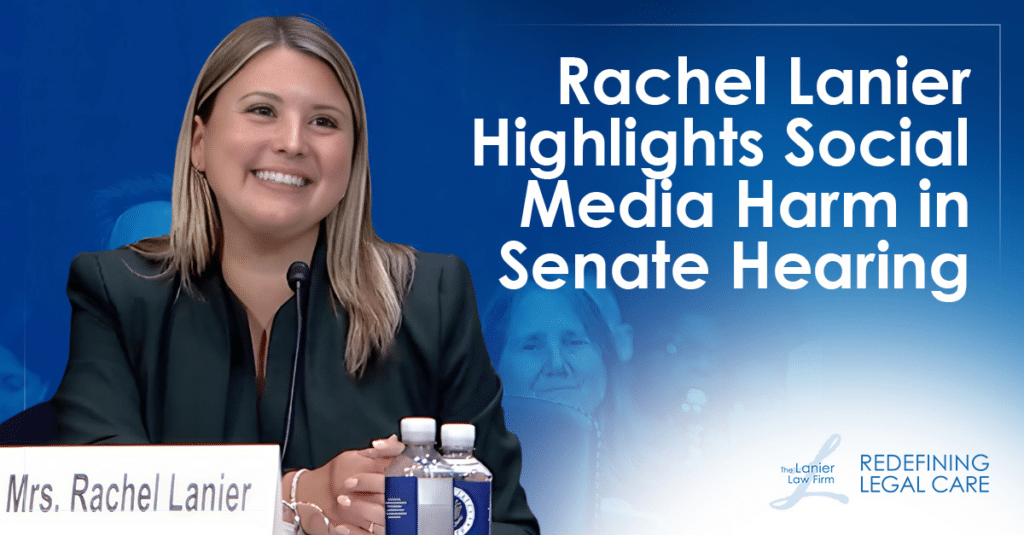
On May 13, 2026, Rachel Lanier, Los Angeles managing attorney at The Lanier Law Firm, testified before the Senate Judiciary Committee’s Subcommittee on Privacy, Technology, and the Law during a hearing titled “From the Courtroom to Congress: Why Landmark Social Media Verdicts Demand Federal Action to Protect Kids Online.” The hearing examined how social media platforms impact children and the need for federal oversight.
Key Points From Rachel Lanier’s Testimony
Lanier emphasized that social media companies like Meta and Google deliberately engineered their platforms to maximize engagement, often at the expense of children’s mental health. Drawing from her trial experience in KGM v. Meta and Google (the first U.S. jury verdict on social media addiction), Lanier explained that internal company documents revealed companies were aware of the risks to adolescents yet prioritized profit over safety.
She highlighted specific concerns, including:
- Features like infinite scroll, algorithmic feeds, and push notifications were designed to keep children engaged for longer periods
- Internal research identified adolescents, girls, children with pre-existing mental health challenges, and low socio-economic status as particularly vulnerable to harm
- Age restrictions were inadequately enforced, and tools for parental supervision often failed to counteract problematic use
- Features such as beauty filters could negatively impact body image among minors
Lanier also stressed the role of legislation in protecting children and suggested the Committee review Section 230 and consider removing social media platforms entirely from Section 230 protection, or, if not possible, then at least carving out children so there’s no Section 230 immunity for harm done to minors.
Rachel also mentioned that “companies should not receive immunity for engineering choices made to maximize engagement,” and said that to those worried about the First Amendment, it “stands on its own. Free speech does not require addictive design.”
Mrs. Lanier also asked for support for targeted legislation, such as the Algorithmic Accountability Act, and urged the Committee not to strip away tools that help ensure social media companies do not escape accountability.
She noted, “The courtroom is one of the most powerful tools we have to force accountability when there is wrongdoing.” She continued, “Any legislation (whether the Kids Online Safety Act, bills that reform Section 230, place guardrails on AI chatbots, or other technology bills) must set a floor, not a ceiling, for the standard of protection. Congress can and should establish minimum standards. But state laws, tort claims, and consumer protections that go further must also be preserved.”
About The Lanier Law Firm and Social Media Addiction Litigation
The Lanier Law Firm is the first firm in the nation to try a social media addiction lawsuit on behalf of a bellwether plaintiff in Los Angeles Superior Court. This landmark case explored whether major social media platforms deliberately designed addictive features that may have contributed to the youth mental health crisis.
The Los Angeles County Superior Court jury in this case ordered Meta Platforms Inc. and Google’s YouTube to pay $3 million in punitive damages, combined with the jury’s earlier $3 million compensatory damages award. The total damages verdict secured by The Lanier Law Firm against the two companies stands at $6 million.
The Lanier Law Firm has been a leader in legal advocacy for many years, and this landmark case shows we remain at the forefront of social media addiction litigation, supported by an award-winning legal team that includes Mark Lanier, Rachel Lanier, Sarah Lanier, Michael Akselrud, Michelle Greene, and Abigail Harris.