Social Media Addiction Lawsuit: Landmark Trial Legal Team
The Lanier Law Firm’s Founder Mark Lanier and co-lead counsel achieved the first successful verdict in a social media addiction case for K.G.M., whose story is now a landmark case in holding social media giants accountable.
We work on a contingency fee basis. There are no upfront costs. If your child has experienced these harmful effects, we’re here to help. Contact us today at 800-723-3216 for a free case evaluation.
Home » Product Liability Litigation » Social Media Addiction Lawsuit
- Legally Reviewed By:
- Rachel Lanier
- Page Last Updated:
- June 12, 2026
Navigate This Page
- Meet the Social Media Addiction Lawyers Behind the Landmark Trial
- Why You’ll Want The Lanier Law Firm to Handle Your Social Media Addiction Lawsuit
- Financial Compensation for Social Media Victims
- Securing Compensation: The Evidence Behind a Social Media Addiction Lawsuit
- Who Can Sue for Addiction to Social Media Platforms?
- What Are the Steps for Filing a Social Media Addiction Lawsuit?
- How Long Do I Have to File A Social Media Addiction Lawsuit?
- Social Media Litigation News
- What Is Social Media Addiction?
- What Are the Signs That Your Child Is Addicted to Social Media?
- How Do Algorithms Encourage Social Media Addiction?
- Did the Social Media Companies Know Their Platforms Were Addictive?
- 2026 Social Media Addiction Lawsuit Updates
- The Road to Justice: 2023, 2024, and 2025 in the Social Media MDL
- Call The Lanier Law Firm to Discuss Your Social Media Addiction Claim
- Legal FAQs About Addiction to Social Media Platforms
Meet the Social Media Addiction Lawyers Behind the Landmark Trial
The Lanier Law Firm put the full might of our legal team and dedicated staff behind the landmark trial that secured a historic $6 million verdict in Kaley’s case against Meta and Google’s YouTube.
We continue to fight for victims of social media addiction, and our experienced legal team is ready to help you pursue justice and compensation if your child has been affected. Meet the attorneys whose expertise can help you secure the justice your family deserves.
Mark Lanier: One of America's Top Civil Trial Lawyers

Mark Lanier, founder of The Lanier Law Firm, led the trial team that secured the $3 million in compensatory damages jury verdict followed by $3 million in punitive damages against Meta and YouTube for the addictive features on their platforms that harmed K.G.M. Mark has been at the forefront of social media addiction litigation and his leadership in the case has helped hold major tech companies accountable for designing platforms that exploit vulnerable children and teens.
Recognized as one of the nation’s top attorneys, Mark’s accolades include Lawdragon’s 500 Leading Plaintiff Consumer Lawyers and Best Lawyers’ Lawyer of the Year for Mass Tort and Personal Injury Litigation. Featured in publications like The Wall Street Journal and The New York Times, Mark’s tireless work continues to protect children from the harms of social media addiction.
“For years, social media companies have profited from targeting children while concealing the addictive and dangerous design features built into their platforms. Today, we finally have accountability. These companies made deliberate choices that prioritized engagement and profit over the well-being of the young people using their products. This verdict sends a clear message to an entire industry that the era of operating without consequence is over.“
– Mark Lanier
Rachel Lanier: Committed to Protecting Teens from Social Media Harm

Rachel Lanier is the Managing Attorney of the Los Angeles Office and a key member of The Lanier Law Firm Trial Team, with a dedicated focus on social media addiction litigation. Rachel has been at the forefront of the fight to hold social media companies accountable for their harmful addictive features, particularly those that impact vulnerable children and teens.
As co-lead counsel in the landmark social media addiction lawsuit, Rachel played a crucial role in exposing how these companies knowingly prioritized profit over the well-being of young users.
Recognized as one of Lawdragon’s 500 Leading Plaintiff Consumer Lawyers and named to Best Lawyers for Mass Tort and Personal Injury Litigation, Rachel is also honored as a Top 40 under 40 Civil Plaintiff Lawyer by National Trial Lawyers.
“This verdict is for every child who has suffered because these multibillion-dollar companies decided that engagement metrics mattered more than the well-being of children. These companies had internal research, and instead of warning parents they made a choice to keep profiting from features they knew were hurting kids.” – Rachel Lanier
Why You’ll Want The Lanier Law Firm to Handle Your Social Media Addiction Lawsuit
- The Lanier Law Firm was the first to take on social media addiction in court: We litigated the first-ever case against Meta and YouTube regarding their addictive features and their impact on youth. No other firm has had the same level of experience or success in handling such landmark cases.
- We provide compassionate legal support for families: We understand the emotional toll of social media addiction and are here to guide you through each step with care.
- We offer you the highest standard of legal care: Exceptional legal knowledge, transparent communication with regular updates, and compassionate support throughout the entire process.
- We have the resources to take on major tech companies: Our experienced team has the capability to challenge billion-dollar corporations and win.
- We’re committed to protecting vulnerable children and teens: We fight to ensure social media platforms change their practices to protect kids, while securing fair compensation for families.
Call 800-723-3216 now to explore your legal options after social media addiction harms your teen. Consultations are free.
The potential consequences of social media addiction can impact every aspect of a victim’s life. For teens, the effects can last a lifetime.
Body dysmorphia and eating disorders can cause severe damage to the body. Depression and anxiety can fundamentally change the course of a young person’s life, driving them away from friends and family and onto dangerous paths.
Through a social media addiction lawsuit, you can demand compensation for the financial, physical, and emotional consequences you’ve endured.
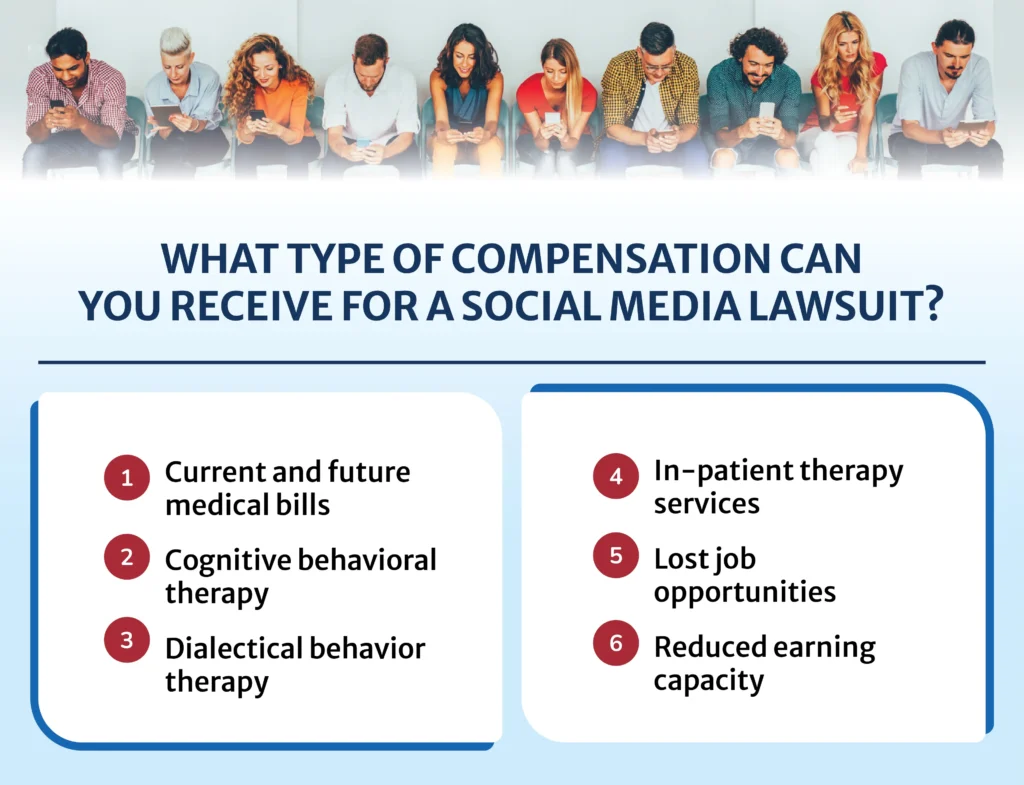
Potential damages can include money for:
- Current and future medical bills
- Cognitive behavioral therapy
- Dialectical behavior therapy
- In-patient therapy services
- Lost job opportunities
- Reduced earning capacity
- Emotional distress
- Embarrassment
- Damage to reputation
- Wrongful death of a family member
You can also send a clear message to social media companies by seeking punitive damages, which can be awarded when there’s clear and convincing evidence that they intentionally caused harm or knowingly failed to disclose the risks associated with their apps and platforms.
Your lawsuit is an opportunity to hold these money- and power-hungry corporations accountable for their actions, while protecting future users from the same fate.
Securing Compensation: The Evidence Behind a Social Media Addiction Lawsuit
Social media companies were aware of the harm they were causing, and we have the evidence that won the jury verdict in K.G.M’s case. Evidence that can be used to help you secure the compensation you deserve.
Internal documents used to support social media addiction claims include:
- Meta internal emails approving the lift of cosmetic surgery AR effects
- Google emails stating “Goal is not viewership, it’s viewer addiction”
- Internal research on the feedback loop and link between social media use and mental health harm in children
- Meta emails acknowledging inability to enforce age restrictions and awareness of harm
- Meta documents on retention strategies targeting tweens
- Employee chat on algorithms optimizing VPVs and sessions for teens
- Instagram head self-review showing his primary goal was ensuring the app remained “culturally relevant as measured by session time and sharing, particularly with teens”
- YouTube document showing main app intended for over 13 used by children 4 and under
- Google Internal Viewers All Hands presentation laying out their means to achieve this “addiction” goal: increasing watch time
- Google in-house ethicist presentation on human vulnerabilities and Intermittent Variable Rewards (“slot machines”)
- YouTube Main App team document stating goal: “We aspire to be an app that is… Addictive”
- Meta 2015 document noting 4 million children under 13 using Instagram (about 30% of 10–12-year-olds in the U.S.)
- Internal research linking 10+ hours of weekly social media use to 56% likelihood of unhappiness in eighth graders
- Meta research showing parental digital supervision does not improve teens’ ability to resist social media
These materials help demonstrate the real-world impact of social media addiction and how platforms were intentionally designed to hook young users. If your child has been harmed by social media, we are committed to using all the evidence and experience our firm has to secure compensation on your behalf.
Who Can Sue for Addiction to Social Media Platforms?
Social media lawsuits have taken the nation by storm, with more than 1,200 families (and counting) taking legal action.
Americans may have the right to file a lawsuit for social media addiction if:
- You or your children started using one or more social media apps, including Instagram, Facebook, TikTok, Snapchat, or YouTube, between 5 and 17 years of age
- You or your children have since used these apps 3 or more hours daily
- You or your children have suffered one or more of the following injuries:
- Body dysmorphia
- Eating disorders
- Depression
- Severe anxiety
- Physical self-harm
- Suicidal ideation
- Suicide
- You or your children have sought or received treatment for said psychological or physical harm
What Are the Steps for Filing a Social Media Addiction Lawsuit?
There are several steps involved in pursuing a social media addiction lawsuit. These cases are complex and high-stakes. They involve claims against some of the largest tech companies in the world, including Meta, YouTube, TikTok, and Snapchat. Successfully pursuing these cases requires experienced attorneys who understand the unique challenges involved.
To help illustrate how these cases move forward, here is a general overview of the key steps involved in pursuing a social media addiction claim:
- Choose an Experienced Attorney: The first step is selecting a lawyer with a proven track record in complex litigation against major tech companies. Attorneys like our founder Mark Lanier have proven they know how to build and win cases against some of the largest social media platforms.
- Retain Representation and Gather Evidence: After hiring an attorney, your legal team will review the details of your case. They will help collect evidence showing the negative impact social media has had on your life or your child’s life.
- File the Lawsuit: Once the evidence is prepared, your attorneys may file a complaint in the proper court and within the legal deadline. Some cases may join larger, coordinated federal litigation, allowing similar claims from across the country to move forward together.
- Litigate the Case: Your legal team will manage all phases of litigation, including gathering additional evidence, working with experts, and responding to defenses from the companies.
- Pursue the Best Possible Outcome: Finally, your attorneys will work to achieve the most favorable resolution, whether through a settlement or trial.
How Long Do I Have to File A Social Media Addiction Lawsuit?
The time you have to file a claim for social media addiction depends on the statute of limitations in your state. It’s important to consult with an attorney as soon as possible to ensure your case is filed within the required time limits.
Call 800-723-3216 now to explore your legal options after social media addiction harms your teen. Consultations are free.
Social Media Litigation News
Explore the latest news in social media litigation from the trailblazing attorneys who won the first social media addiction lawsuit in the nation.
- Rachel Lanier testified before the Senate during a hearing titled “From the Courtroom to Congress: Why Landmark Social Media Verdicts Demand Federal Action to Protect Kids Online.”
- Mark Lanier Takes You Inside the Social Media Addiction Trial Courtroom
- Sarah, Rachel, and Mark Lanier Featured on Christianity Today: The Social Media Addiction Trial & Luke 10:25–37
- Jury Orders $3 Million in Punitive Damages Against Meta and YouTube
- Jury Hits Meta and YouTube with $3 Million Compensatory Verdict
- Michelle Greene on Social Media Litigation Webinar
- Arkansas AG Retains Lanier Law Firm to Prosecute Claims Against Meta
What Is Social Media Addiction?
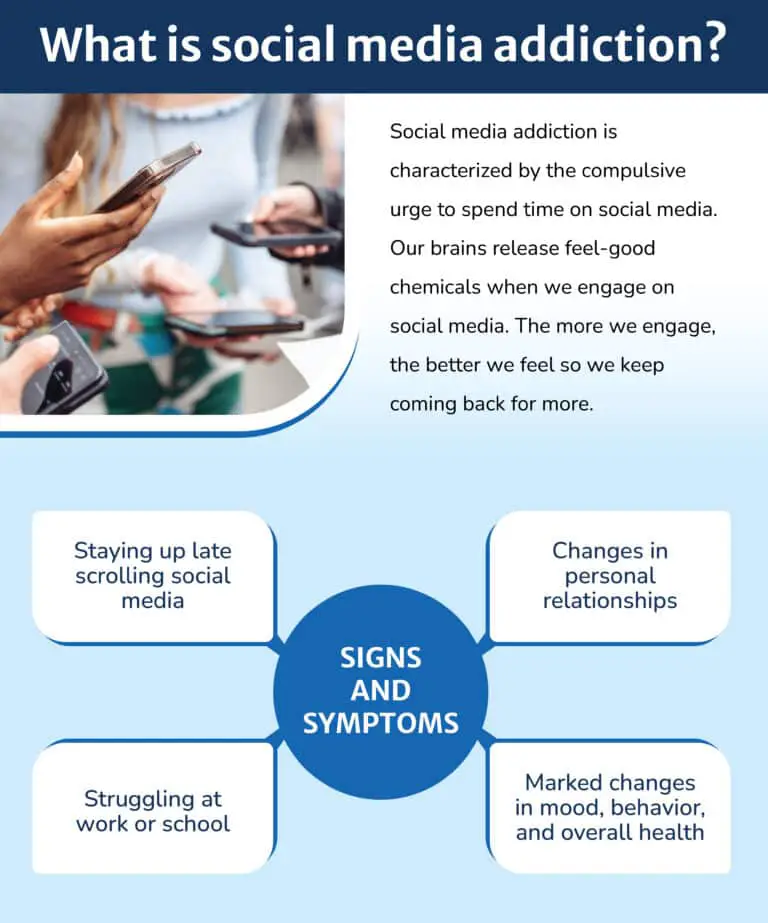
Social media addiction is the compulsive urge to access and engage with social media platforms at the expense of attending to other areas of your life. While adults are not immune to the urges of social media use, kids and teens are more susceptible because their neurological development is still progressing, particularly executive functioning and decision-making abilities. As a result, your child may find it more difficult to walk away from social media, even if they realize it isn’t good for them.
What Are the Signs That Your Child Is Addicted to Social Media?
Teenagers who are addicted to social media often report:
- Depression
- Anxiety
- Body dysmorphia
- Eating disorders
- Loneliness
- The fear of missing out (FOMO)
- Isolation
- Low self-esteem
- Jealousy
- Worthlessness
- Difficulty with personal relationships
- Suicidal thoughts
If you’ve experienced these symptoms or recognize them in your teenager, speak with a licensed mental health professional about your social media use.
You may also want to speak with an experienced social media addiction lawyer, as you may have the right to take legal action if you’ve suffered any ill effects.
How Do Algorithms Encourage Social Media Addiction?
Social media platforms like Facebook, Instagram, YouTube, and TikTok are billion-dollar companies that profit through advertising. The longer users spend on these platforms, the more money these companies make.
- The Incentive: These companies have a strong incentive to make users crave social media and keep coming back.
- The Definition of Social Media Algorithms: Algorithms are sets of instructions that determine which content to show users based on their interests and behaviors. Ideally, they should filter out irrelevant content and provide a personalized experience.
- The Reality: In practice, the more we see content we like or that triggers an emotional response, the more time we spend scrolling. The more “likes” and notifications we get, the more addictive social media becomes, as they release dopamine, the brain’s feel-good chemical.
- How Social Media Companies Use Algorithms: These platforms use advanced algorithms to make their products even more addictive, ensuring users stay engaged longer.
- The Impact on Mental Health: The longer users, especially teens and young adults, spend on social media, the higher the risk of mental health issues like depression, anxiety, and suicidal ideation.
- Key Social Media Addiction Statistics:
- Teens who spend three or more hours online daily are at increased risk for mental health problems.
- The average teen spends 3 hours and 1 minute on social media daily, with some spending up to 7 hours.
Transcript:
Zeke DeRose:
So, there are a number of things that make social media addicting, but part of it is that the apps are gamified, right?
They act as though a similar addiction to alcoholism or gambling, and it sets off a dopamine release that triggers this want for more.
And, what we’re seeing with social media companies, especially with targeting kids, is they realize that the longer they keep people on an app, the longer they keep you on your iPhone or your iPad, the more addictive it becomes and the more valuable you are for their advertising.
And, the things that are more addictive are divisive content, sensational content, sexual content, and things that keep you, and violence, and so it’s similar to a slot machine when you’re pulling the lever on the slot machine and you’re waiting for that to land and you’re wondering what is it going to land on and that anticipation is addicting.
And, sometimes what we found, too, or what we’re finding, is that delay when you’re scrolling through your feed is not because you have a slow Wi-Fi connection or bad service, but it’s intentional to create that delay, to create that anticipation.
Rachel Lanier:
Everybody likes feeling liked and especially when you are a young person, you’re growing, you’re figuring out kind of who you are and trying to put out a certain version of yourself.
And, we found that a lot of these social media apps are very tricky because for younger users they, especially, are susceptible to feeling liked and this is their affirmation and how they get a lot of their self-esteem is when somebody hearts their post or clicks a like button for them, it provides a lot of self-esteem to them.
This is also a huge form of socialization for this group of individuals, especially adolescents. It allows them to feel connected to others, but unfortunately, even though certain things in the apps, seem very innocent, we have found, that the makers of the apps have intentionally created this addictive system to keep you on the apps as long as possible so that you hopefully make money for them.
And it’s a real shame.
Did the Social Media Companies Know Their Platforms Were Addictive?
Social media companies kow their platforms are addictive and they don’t care.
Facebook, Instagram, TikTok, and Snapchat, among others, are built to be addictive.
According to Facebook’s former director of monetization, Tim Kendall, Facebook knowingly made its social media platform “as addictive as cigarettes.”
In an interview, Kendall acknowledged that Facebook’s objective is to “get more people to pay attention to your product and to pay attention longer each and every day.” The company created algorithms to make this happen, essentially luring vulnerable and impressionable teenagers onto the platform.
Kendall called Facebook “fundamentally addictive” and admitted that “it’s causing all kinds of mental health issues … [and] eroding aspects of society.”
Kendall’s sentiments were confirmed by Facebook whistleblower Frances Haugen, who testified before the U.S. Committee on Science, Commerce, and Transportation on October 4, 2021.
In her testimony, she explained that Facebook executives “repeatedly encountered conflicts between its own profits and our safety” and “consistently resolved those conflicts in favor of its own profits.”
Simply put, social media companies knowingly prioritize profits over the health and well-being of their users. If your child has been hurt by social media, contact our firm today.
Get a Free Legal Consultation
- Experienced trial lawyers helping families impacted by social media addiction
- Over $20 billion recovered for our clients
- No upfront costs or fees
2026 Social Media Addiction Lawsuit Updates
June 10, 2026: Meta and YouTube Appeal Denied
The Lanier Law Firm secured a major victory when the court denied Meta and YouTube appeal motions to overturn the $6 million jury verdict. Lanier Law Firm managing attorney Rachel Lanier noted that the Court rejected the corporate giants’ arguments regarding Section 230, the First Amendment, and causation, finding the punitive damages award well-supported by evidence that the platforms willfully disregarded minor safety. With more than 1,600 plaintiffs consolidated in this litigation, the trial team is now focused on the next trial scheduled to begin July 27.
April 6, 2026: Meta and Google Plan to Appeal
The fight continues, and Meta and Google have said they will appeal. We expect the road ahead to be long, but the landmark social media addiction verdict on March 25th remains a meaningful step forward for this litigation.
March 25, 2026: Mark Lanier Secured $6 Million Social Media Addiction Verdict
The first social media addiction case in the nation was tried by The Lanier Law Firm as lead trial counsel. Mark Lanier, Rachel Lanier, and Sarah Lanier led the charge at trial, backed by the full strength of our team of attorneys and staff who poured themselves into this case. The trial resulted in a jury verdict ordering Meta Platforms Inc. and Google’s YouTube to pay $3 million in compensatory damages and $3 million more in punitive damages for deliberately designing addictive features on their platforms that contributed to severe mental health harm in a young woman during her preteen and teenage years.
The jury found that Meta was 70% responsible and YouTube 30% responsible for the harm, resulting in $4.2 million awarded against Meta and $1.8 million against Google. The plaintiff, Kaley, bravely took her case to trial and won, holding two of the most powerful companies in the world accountable for the harm their platforms caused her.
The total $6 million landmark verdict is the first jury verdict of its kind anywhere in the country, and it is a significant development for this litigation and everyone involved in it.
January 23, 2026: Snapchat Settles, The Lanier Law Firm Moves to Trial
The Lanier Law Firm is set to be the first firm in the nation to try a social media addiction case on behalf of a bellwether plaintiff when trial begins January 27, 2026 in Los Angeles Superior Court.
This landmark case will examine whether major social media platforms deliberately designed addictive features that have contributed to a youth mental health crisis. Mark Lanier and Rachel Lanier, co-lead counsel in the JCCP coordinated proceeding, will serve as lead trial counsel for the plaintiffs, supported by Lanier Law Firm attorneys Michael Akselrud, Michelle Greene, Abigail Harris, and Sarah Lanier.
The outcomes of these bellwether trials could set important precedents for how social media platforms design their products and interact with young users and may lead to significant settlements or industry-wide changes to protect youth mental health.
Tuesday, Snapchat settled the claims in this first trial.
Thousands of plaintiffs, including individuals and school districts, have brought claims against Meta (Facebook and Instagram), Google (YouTube), ByteDance (TikTok), and Snap Inc. (Snapchat), alleging that these platforms were intentionally designed with features such as “infinite scroll” and autoplay to maximize user engagement at the expense of young users’ mental health. The lawsuits contend that these design choices have contributed to widespread anxiety, depression, and body dysmorphia among youth users. The court has ordered testimony from high-level executives, including Meta CEO Mark Zuckerberg, Instagram head Adam Mosseri, Snap CEO Evan Spiegel, and YouTube CEO Neal Mohan.
The Road to Justice: 2023, 2024, and 2025 in the Social Media MDL
- September 2025: Rachel Lanier leads the California JCCP social media addiction litigation, overseeing expert depositions as the trial approaches.
- May 2025: The court selected nine bellwether cases to proceed to trial, with discovery continuing, including depositions from Snap’s CEO Evan Spiegel.
- January 2025: Judge Kuhl issued this order denying the Defendants’ demurrer and motion to strike claims involving failure to warn, clearing the way for Plaintiffs to pursue such claims in the ongoing social media addiction litigation. A California appellate court summarily denied Defendants’ petition for a writ of mandate challenging an order from Judge Kuhl denying Defendants’ motion to strike claims because of purported §230 protections.
- December 2024: An appellate court denied the platforms’ petition in appeal.
- October 2024: A federal judge has allowed a major lawsuit by school districts against social media companies to proceed, marking a significant development in the ongoing battle over youth safety online. The case consolidates hundreds of claims from plaintiffs, including injured individuals, school districts, and state attorneys general, against platforms like Facebook, Instagram, YouTube, TikTok, and Snapchat. Judge Gonzalez Rogers’ 45-page ruling rejected the platforms’ attempts to dismiss the case. Notably, the order clarified that Section 230 and First Amendment protections don’t shield platforms from claims related to inadequate age verification systems, insufficient parental controls, and lack of default limits on usage time and frequency.
- September 2024: The parties are continuing to engage in discovery, and depositions of corporate witnesses are scheduled over the coming months. The parties have agreed to a four-month trial extension. The school districts have filed notices of appeal.
- June 2024: The California JCCP ruled that four school districts cannot pursue claims against Meta, Snap, Google, YouTube, and TikTok for disrupting education. In a different case against Meta, the Ninth Circuit reiterated that that Section 230 is “not limitless,” with one judge calling on the Ninth Circuit to reexamine precedent that broadly interprets Section 230. Individual cases remain active.
- April 2024: In the federal MDL, both sides have selected bellwether trial cases. In mid-June, the California court will randomly select 24 bellwether cases, with trials set to begin in June 2025. Meanwhile, both parties continue to identify witnesses and negotiate document production.
- March 2024: The Lanier Law Firm has filed additional cases against social media companies, and several courts have now ruled that lawsuits can proceed. The companies have been ordered to engage in discovery and to produce documents that concern their harmful conduct.
- January 2024: In a Senate Judiciary Committee hearing, lawmakers questioned social media CEOs about the risks their platforms pose to children, focusing on child exploitation and the mental health impacts of social media. CEOs from Meta, TikTok, Snapchat, X, and Discord acknowledged shortcomings. Meanwhile, nearly 500 actions are filed against social media companies, with the Lanier Law Firm leading the push for greater transparency and document production to expose negligent conduct.
- November 2023: A Senate Judiciary Subcommittee heard testimony from a whistleblower who revealed that Meta knew about the harm young users faced on Facebook and Instagram but ignored safety recommendations. Senators also called for the passage of the Kids Safety Online Act, aimed at protecting children and teens on social media.
- October 2023: The California JCCP ruled that negligence claims against social media companies can move forward, allowing lawsuits for harm to minors despite Section 230 protections. 408 cases are currently pending in the MDL. Additionally, a bipartisan group of 42 attorneys general filed a federal lawsuit against Meta, accusing Facebook and Instagram of targeting children and teens with addictive features and violating COPPA.
- July 2023: Key deadlines are met in the Social Media Addiction Multi-District Litigation (MDL), and arguments over Section 230 protections continue.
- March 2023: The Arkansas Attorney General and Governor announced that The Lanier Law Firm would join them in pursuing litigation against Meta for neurological disorders caused by excessive social media use among children and teens.
Call The Lanier Law Firm to Discuss Your Social Media Addiction Claim
Social media is deliberately designed to be addictive. With addiction comes the risk of serious physical and mental health problems, including suicidal tendencies, eating disorders, and distorted self image.
Whether you’re personally struggling with social media addiction or caring for a teen or young adult who has become addicted, you shouldn’t have to bear this burden on your own.
Social media giants created this epidemic. They must be held accountable. The Lanier Law Firm is ready to stand beside you and fight for the justice you deserve.
We’re continually recognized as some of the most compelling, compassionate, and successful trial attorneys in the nation. Now, we’re ready to invest our considerable experience and resources in your social media addiction case.
We’re standing by 24 hours a day, seven days a week. Call us at 800-723-3216 or contact us online to schedule a free consultation today.

Rachel Lanier is dedicated to pharmaceutical and product liability, helping secure the $4.6 billion verdict in Ingham v. Johnson & Johnson. Recognized by Best Lawyers (2024-2025) for Mass Tort and Personal Injury, Rachel leads the firm’s social media addiction lawsuits and represents clients in high-profile MDLs.
Legal FAQs About Addiction to Social Media Platforms
What Kind of Evidence Is Needed To Support a Social Media Addiction Claim?
The evidence required for a social media addiction lawsuit may include platform usage records, medical or therapy documentation, school or work reports, and other records demonstrating harm. An experienced attorney will help gather evidentiary support to build a strong case.
What Is the Average Payout for Social Media Platform Addiction Lawsuits?
The payout in social media addiction lawsuits can vary significantly depending on the severity of the harm, the company involved, and the details of the case. In some landmark cases, like the one handled by the Lanier Law Firm, the compensation has reached into the millions. While individual payouts can differ, cases involving serious mental health impacts or addiction-related harms to minors may result in substantial settlements or jury awards.
How Much Does a Social Media Addiction Lawyer Cost?
Most social media addiction lawyers, including those at The Lanier Law Firm, work on a contingency fee basis. This means you don’t pay upfront fees; the lawyer only gets paid if you win or settle your case.
What Are the Design Features That Make Social Media Addictive?
Features that contribute to social media addiction include infinite scroll, algorithmic feeds, and push notifications that were designed to keep children engaged for longer periods.
Can Social Media Platforms Be Immune to Liability?
For decades, technology companies relied on Section 230 of the Communications Decency Act to shield themselves from virtually all litigation related to their platforms. But recently, our plaintiff attorneys have successfully advanced a theory that treated social media platforms as defective products under California product liability law, focusing not on the content users posted, but on the design features the companies engineered to maximize engagement. As a result, The Lanier Law Firm was the first law firm to try a social media addiction case in the nation and win.
Which Social Media Platforms Are Being Sued?
Major platforms named in social media lawsuits in the United States include:
- Meta: Facing lawsuits against Facebook and Instagram for addictive and harmful features.
- YouTube: Recently found liable of harm and addiction along with Meta.
- TikTok: Facing lawsuits for its addictive nature and promotion of dangerous challenges and content.
- Snapchat: Accused of harm to children, including enabling the purchase of drugs laced with fentanyl through their Snap Maps feature.
- Discord: Closely related to Roblox lawsuits for sexual exploitation and abuse of children.
Other Ongoing Litigations at The Lanier Law Firm























Financial Compensation for Social Media Victims